


Written Friday 22nd May 2026, one day before the gates close on Saturday and before the People’s Choice Award is announced. Some details may shift between posting and reading. That’s the nature of show week. Oh, and this is a long one, AGAIN, so settle in!
My throat is hoarse, my eyes are bloodshot and thanks to the London planes at the heart of the showground I haven’t stopped coughing since Wednesday. After six days at the RHS Chelsea Flower Show, I am nowhere near as tired as the amazing people who have grafted on site since the end of April. And you know what? Both me, and all those amazing people who’ve been putting the show together for our delectation, have had the time of our lives.
This week their tiredness shifts from physical to emotional. The exhaustion dissolved, glass after glass, in near constant champagne, the bubbles in each bottle adding pep to the step and fizz to the veins, without a single person feeling tipsy or (god forbid!) drunk. At Chelsea it isn’t alcohol. It’s fuel.
So, after last week’s preview (and goodness, didn’t some of you respond to that, thank you, properly), here is the review you have been waiting for. My Fitbit is proof of the pounding I gave the walkways of the greatest flower show on earth. I promise I left every garden, stand and display completely intact.

Before we walk it, here is what I will tell you. The show this year was a TRIUMPH. AGAIN. Not even the weather could dampen it (as I type, it is glorious sunshine and 30 degrees in SW3, as if the sky itself wants us to celebrate the great and good of horticulture up there). My preview last week worried away at sponsorship transitions, the AI conversation, Project Giving Back’s farewell, an EV parked in a Main Avenue cloister, and what next year holds. Most of those questions have answers now, and one or two are better answers than I dared hope for.
The press has been telling you Chelsea 2026 is more of the same rewilding, renaturing, naturalistic-meadow story. On the evidence of my own two feet up and down Main Avenue, the press is WRONG. Here are the actual headlines, from my perspective. There is real variety in this year’s gardens. Colour is poking back through (not enough for me yet, but the door is opening). PGB said the farewell it deserved. Sarah Eberle, in her fiftieth year in horticulture, took her THIRD Best in Show. And the conversations I had this week make me more reassured about 2027 than when I went in.
And here is one number to carry with you as we walk. Of the nine large show gardens on Main Avenue this year, only TWO were designed by women. Sarah’s win is hers, properly, three times over. But the broader count has not moved. We have work to do, all of us.
Honestly? On day one there, I had to have a word with myself. I arrived late on Friday afternoon, four days before the show opened, to grizzle and drab, the soul sucked from every garden on Main Avenue as horticultural acrobatics were performed against the clock and the build teams’ nerves began to shatter. As a Judge myself, and a Chelsea exhibitor too, I am highly aware that Chelsea designers and contractors clock those of us in pressed clothes and pristine high-vis jackets, clipboard in hand, all of us trying very hard not to look officious, petrifying, or (the irony) judgemental, from a mile off!
As I mentioned in last week’s preview, I was there as an Assessor of a specific garden category, which I won’t be commenting on here, or indeed on any of the jufging anywhere, ever. The RHS judging code is clear and I abide by it.
What I will say is this. The grey of the light as I arrived was a sort of smokescreen, helpful in the end because it made you look harder. And then on Saturday a literal bolt of light illuminated petal, boulder and steel, and my enthusiasm ignited with it.
In this newsletter, I’m reflecting my own, personal views, and I hope that you’ll enjoy them.
Right. Shall we walk around together?
All About Plants
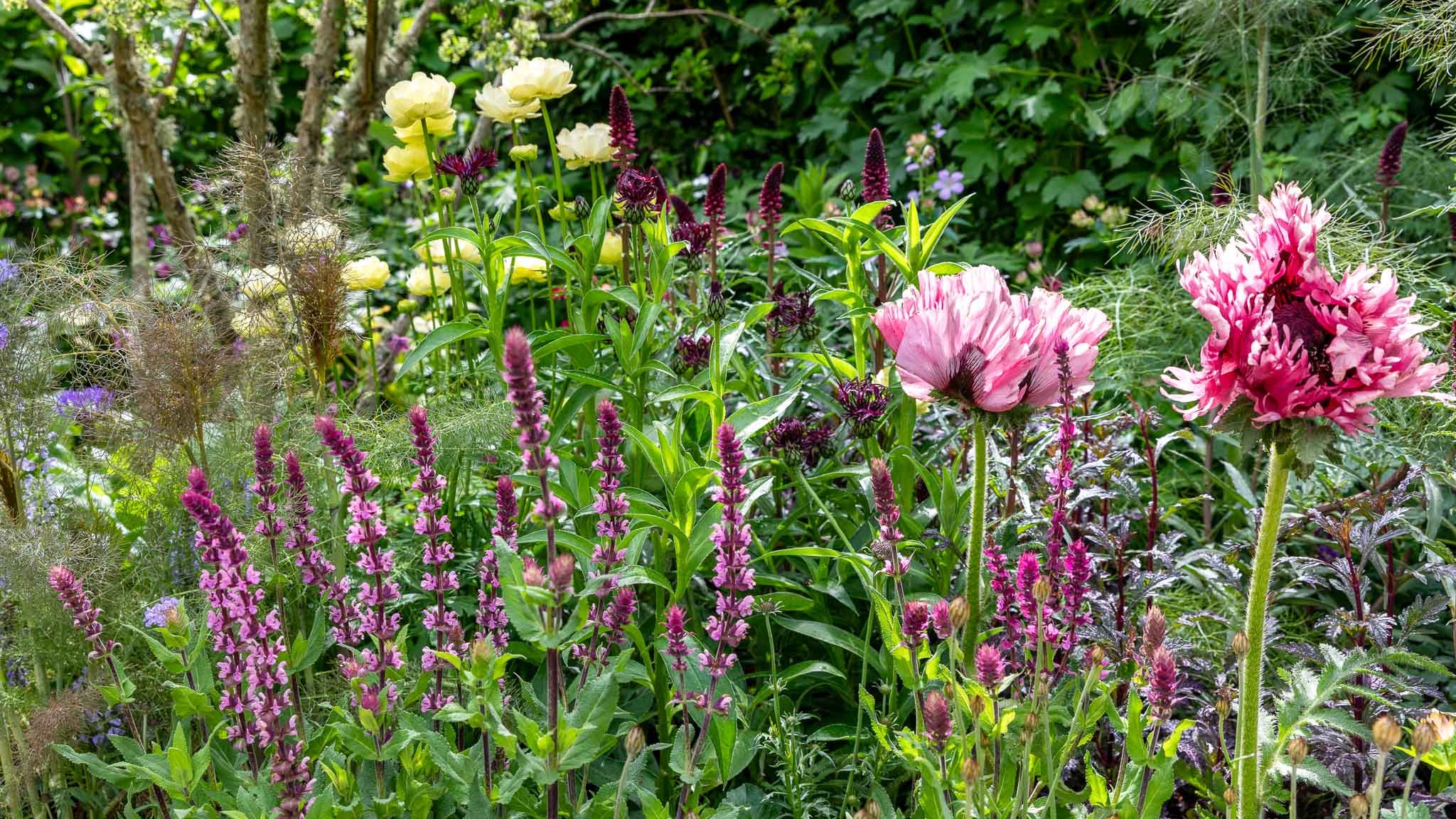
Whoever thought to put the All About Plants category on the triangle deserves a round of applause. Now a couple of years out of the tent (where flower and foliage tones were always slightly skewed by being inside, and lord knows how the plant exhibits always manage to look so good), these were ASTOUNDING in their eloquence. Five gardens, each shaped in collaboration with a UK charity, and wrapped together by an artful knit of planting teased with obvious skill by Jacopo Ducato Ruggeri, an RHS Young Designer finalist at last year’s inaugural Wentworth Woodhouse show, whose work I admired then and wrote I about that show here. Anyway, back to Chelsea, where in the All About Plants category, the inspiration seemed to flow both within and without.
So, here they are, in order of medal.
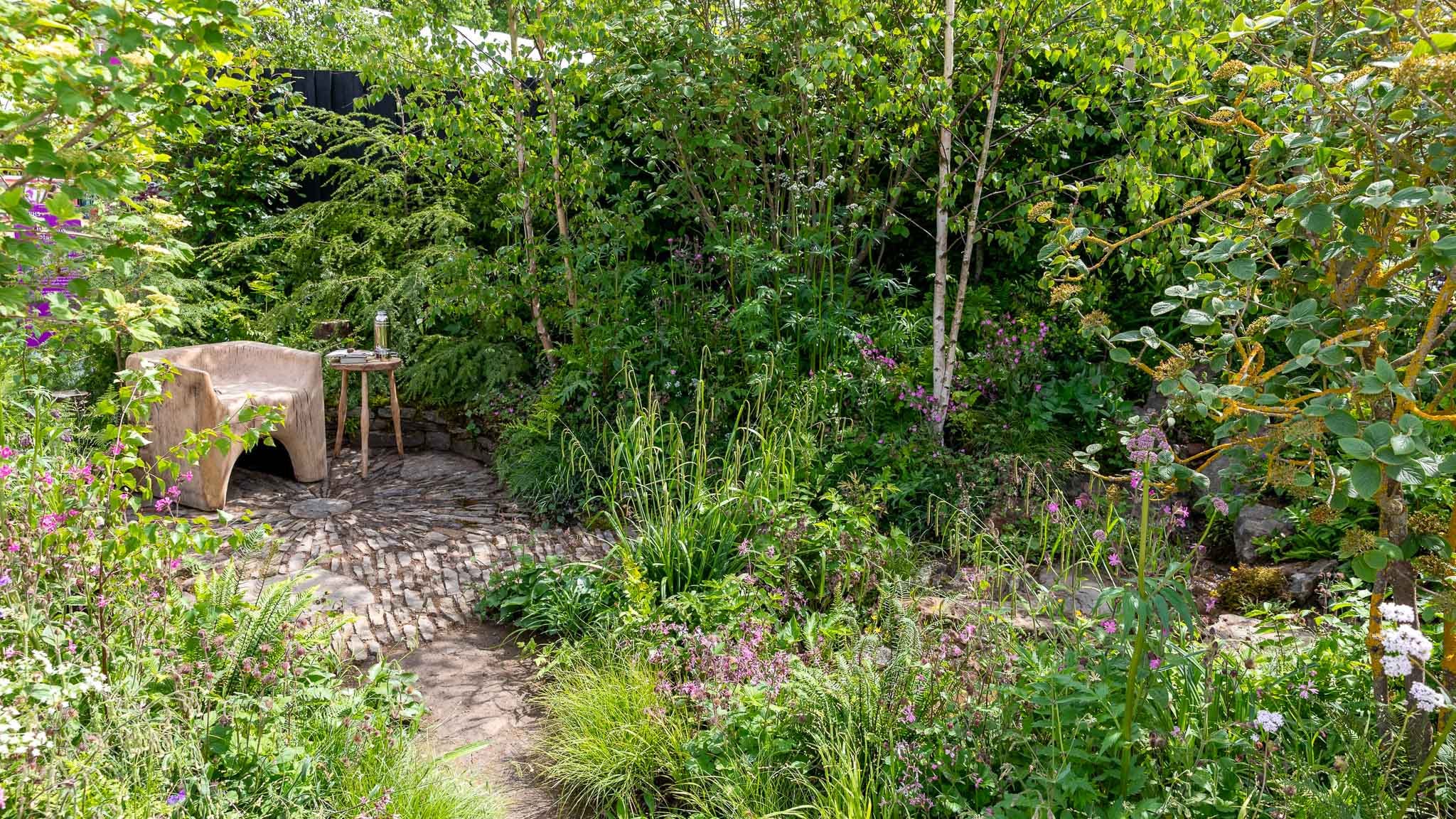
Forgotten Forests — Woodland Trust, designed by Ashleigh Aylett. Gold and Best All About Plants Garden 2026.
The positive argument the garden makes is the one we need to keep making (and yes, I really do think gardeners that gardeners are secretly saving the planet.

Their garden represented that ancient woodlands at breaking point CAN recover, that thriving biodiverse woodland CAN re-emerge from a written-off conifer plantation, if we manage the transition properly. Ashleigh has shown us the transition zone in microcosm. The conifers giving way. The understorey coming through. The light reaching down. Her planting integrity is the real deal, and she has properly arrived. RHS Young Designer of the Year 2024 to boot. WATCH HER.
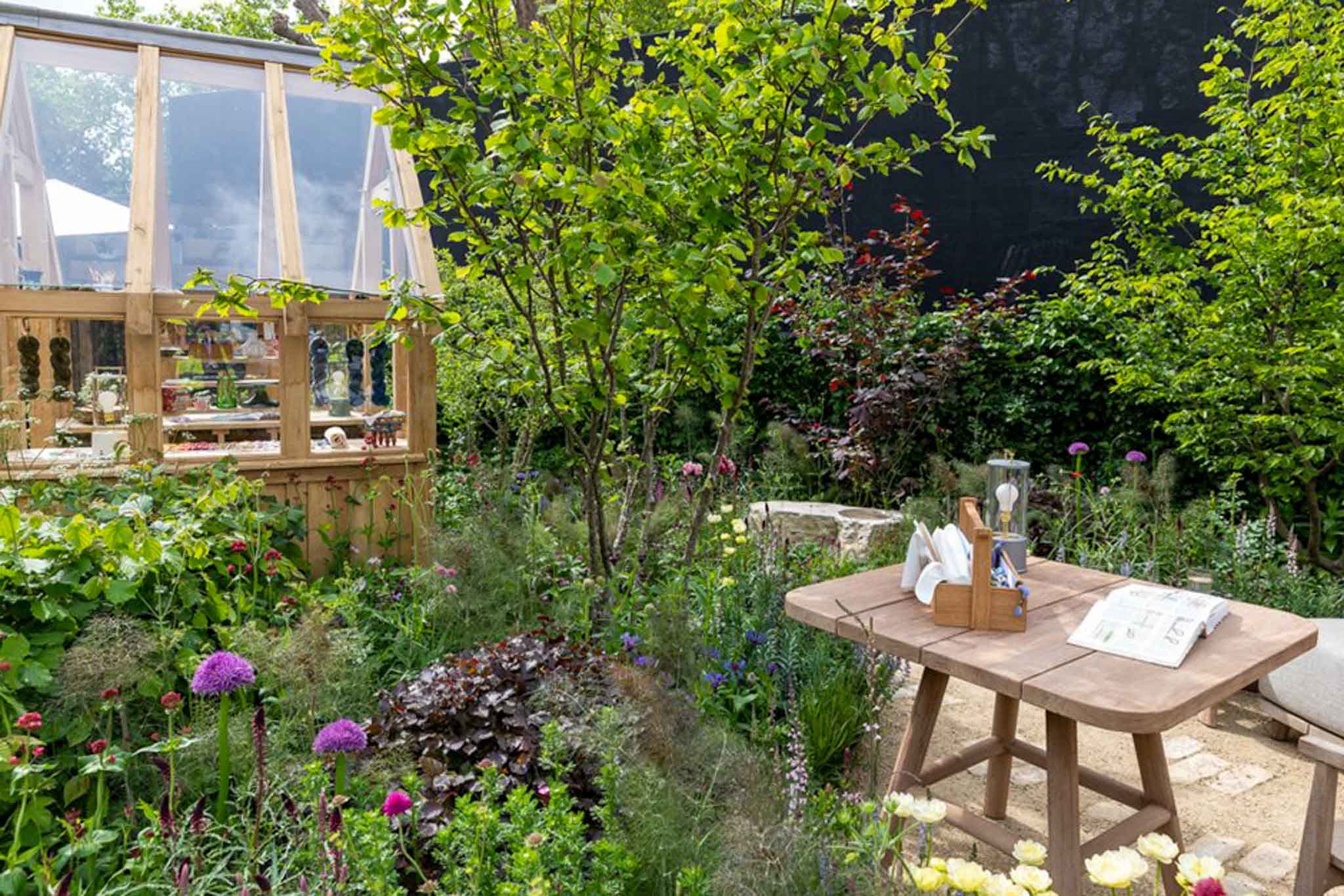
Time for Creativity — Cleary Gottlieb, designed by Christina Cobb. Gold.
A walk-through glasshouse stocked with books, paints, papers and fabrics, with vibrant planting wrapping the soft landscape outside. The point: step AWAY from the screen, pick UP the analogue thing, let the mind rest in colour and pattern. As messages go, that one needs no megaphone. I came out wanting a cup of tea and a sketchbook. Which is the entire point.
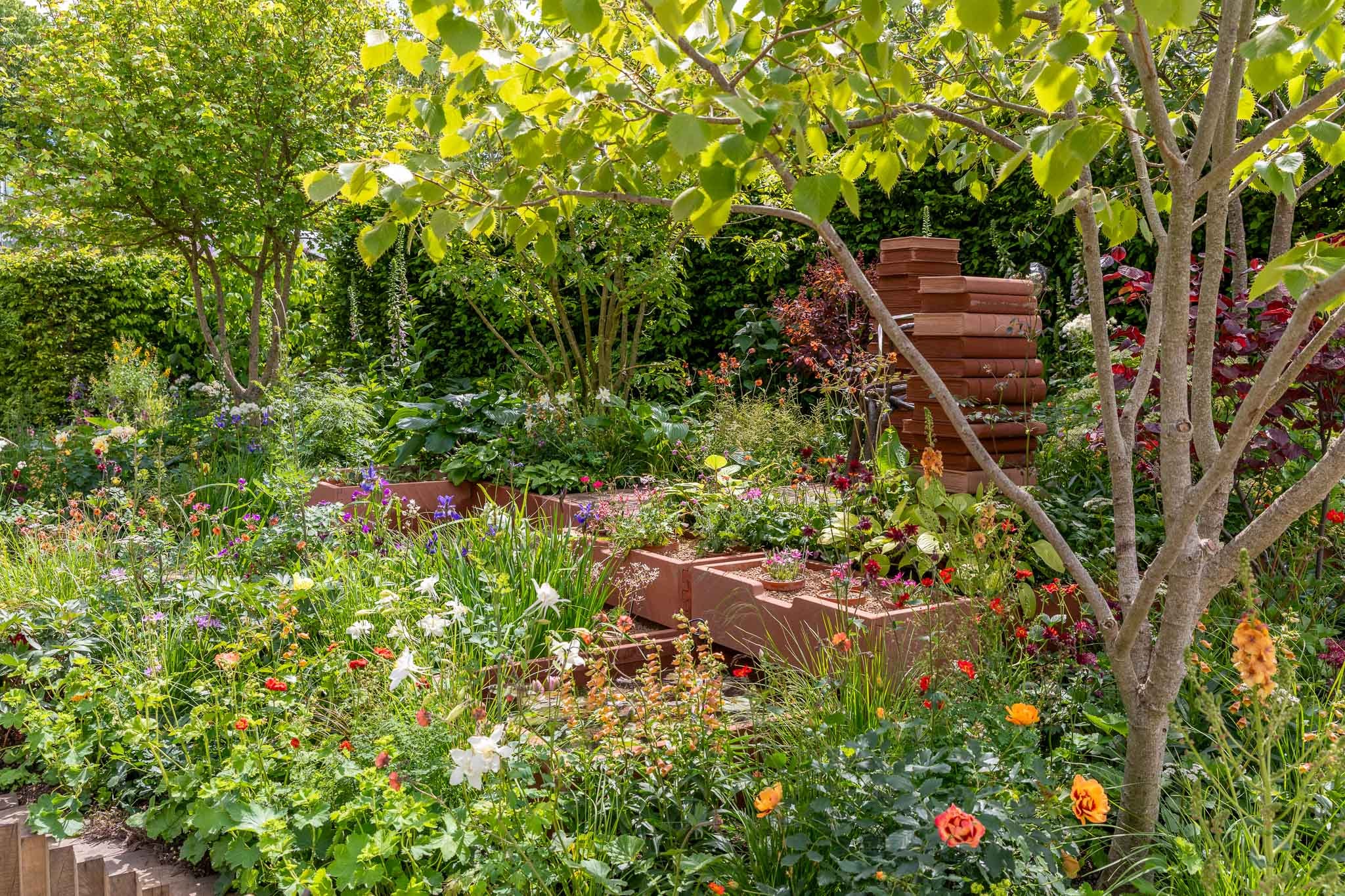
The Missing Collector Garden — Plant Heritage, designed by Kate Campbell, Sally-Anne Rees and William Murray (The Planting Design Collective). Silver-gilt.
For the charity that does the unsung work of keeping the National Plant Collections alive. The story behind the garden: a mysteriously vanished horticultural enthusiast has left this extraordinary plant collection behind. An empty chair invites you to be the collector for a moment. The planting is jewel-toned, glittering against deep glossy green foliage. And the show-stopper for me was Paeonia ‘Callie’s Memory’. An intersectional/Itoh peony, peachy flowers flushed raspberry, the kind of plant that genuinely makes you stop and gasp. The story stuck with me afterwards.
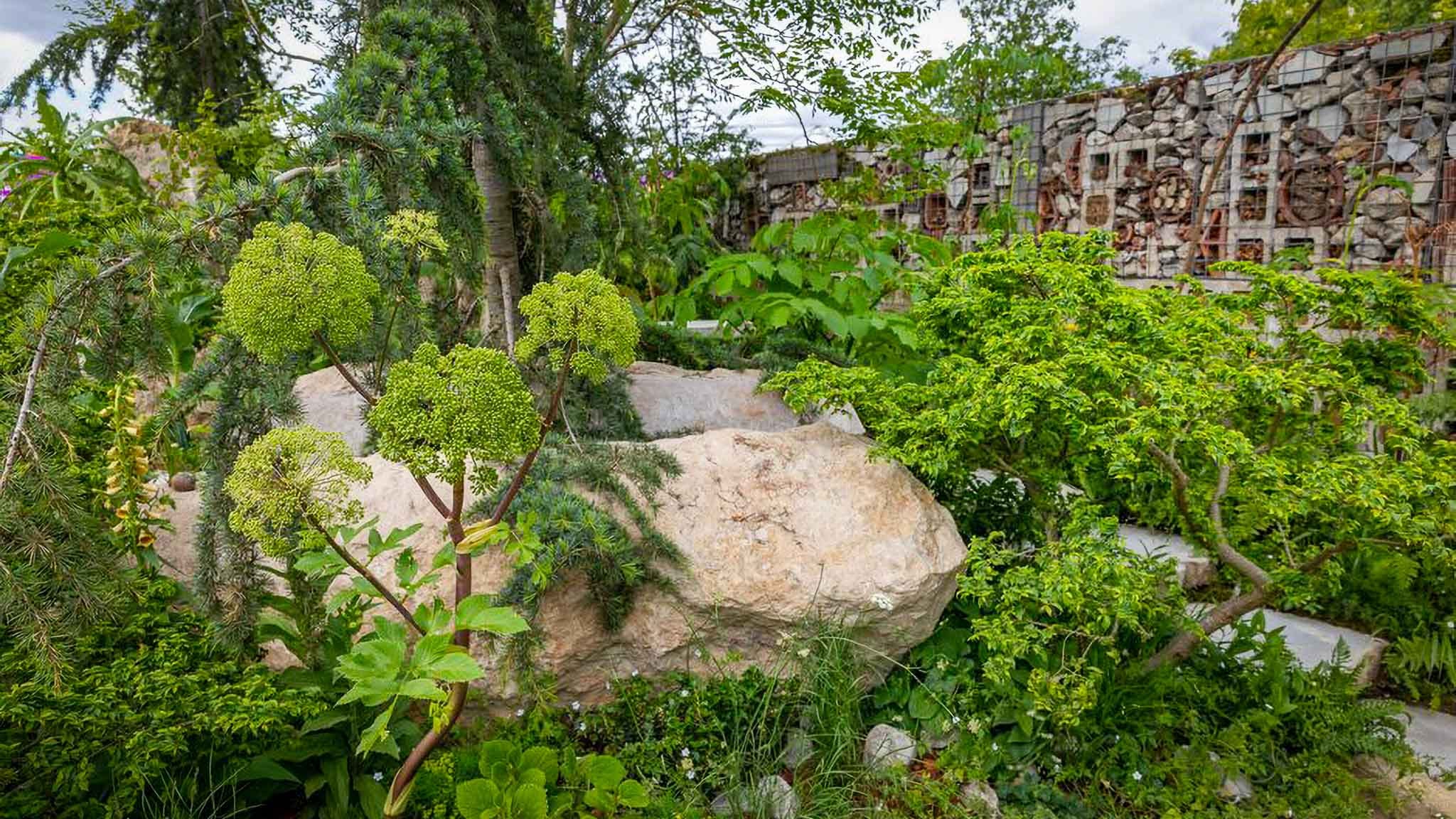
YoungMinds Garden — YoungMinds charity designed by Charlie Chase. Silver-gilt.
This is a garden that doesn’t pretend mental health work is finished, but offers a space where that work CAN happen. The boundary wall is built from stone offcuts, recycled build materials, and lots more too which gives the garden both its enclosure and habitat for wildlife (two jobs from one decision, my favourite kind of design move). The planting is diverse, varied, sometimes coming together in unexpected ways. I adored it.
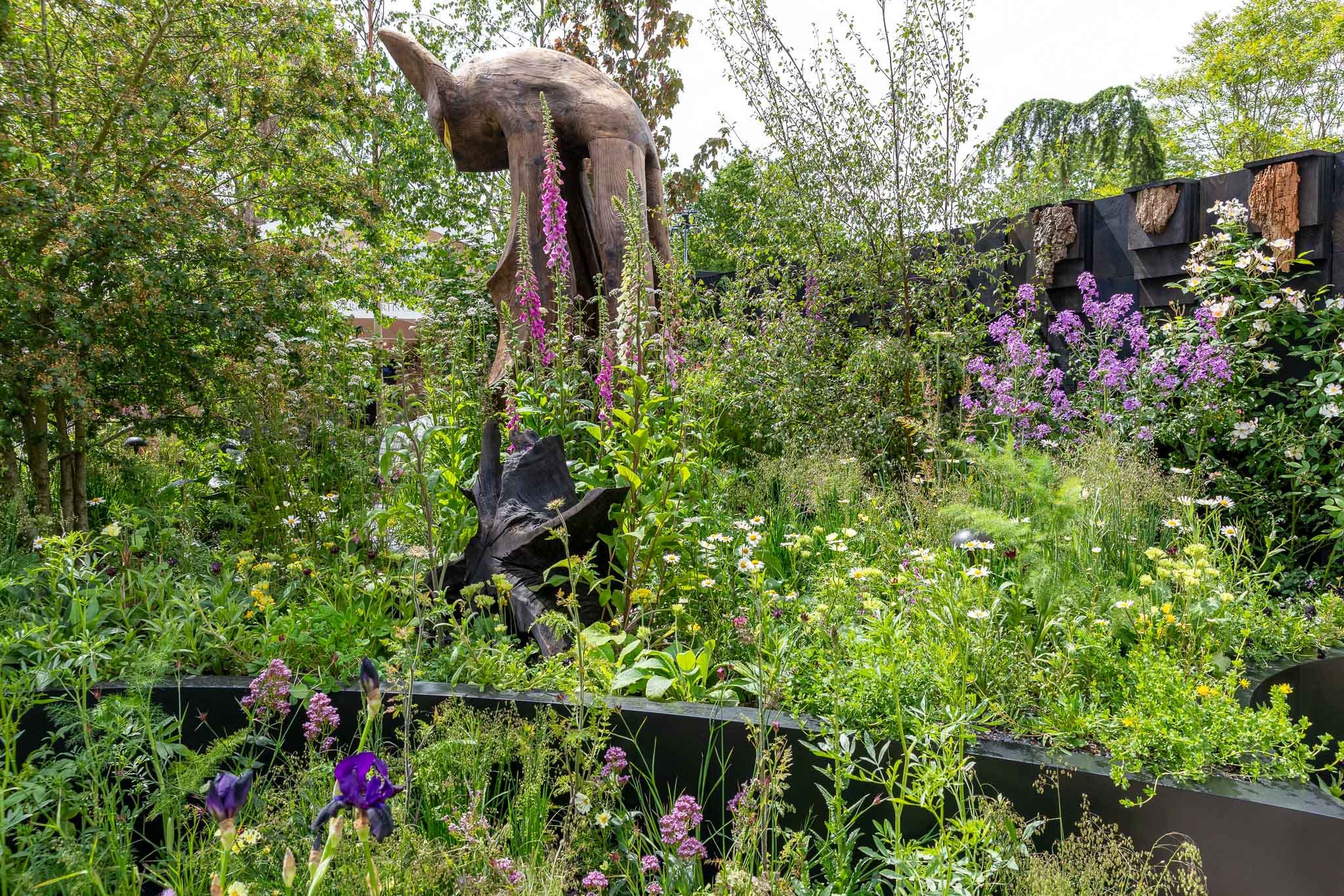
The Nocturnal Garden — Bat Conservation Trust, designed by Melanie Hick. Silver.
Naturalistic planting to feed the tiny insects bats prey on. And here’s the design move that lifted it: the boundary disassembles into bat boxes when the garden is taken down at the end of the show. Two jobs again from one decision. This is the kind of properly thought-through design afterlife that I adore. I quietly, properly loved this. The Bat Conservation Trust’s first big Chelsea moment and I hope it isn’t the last.
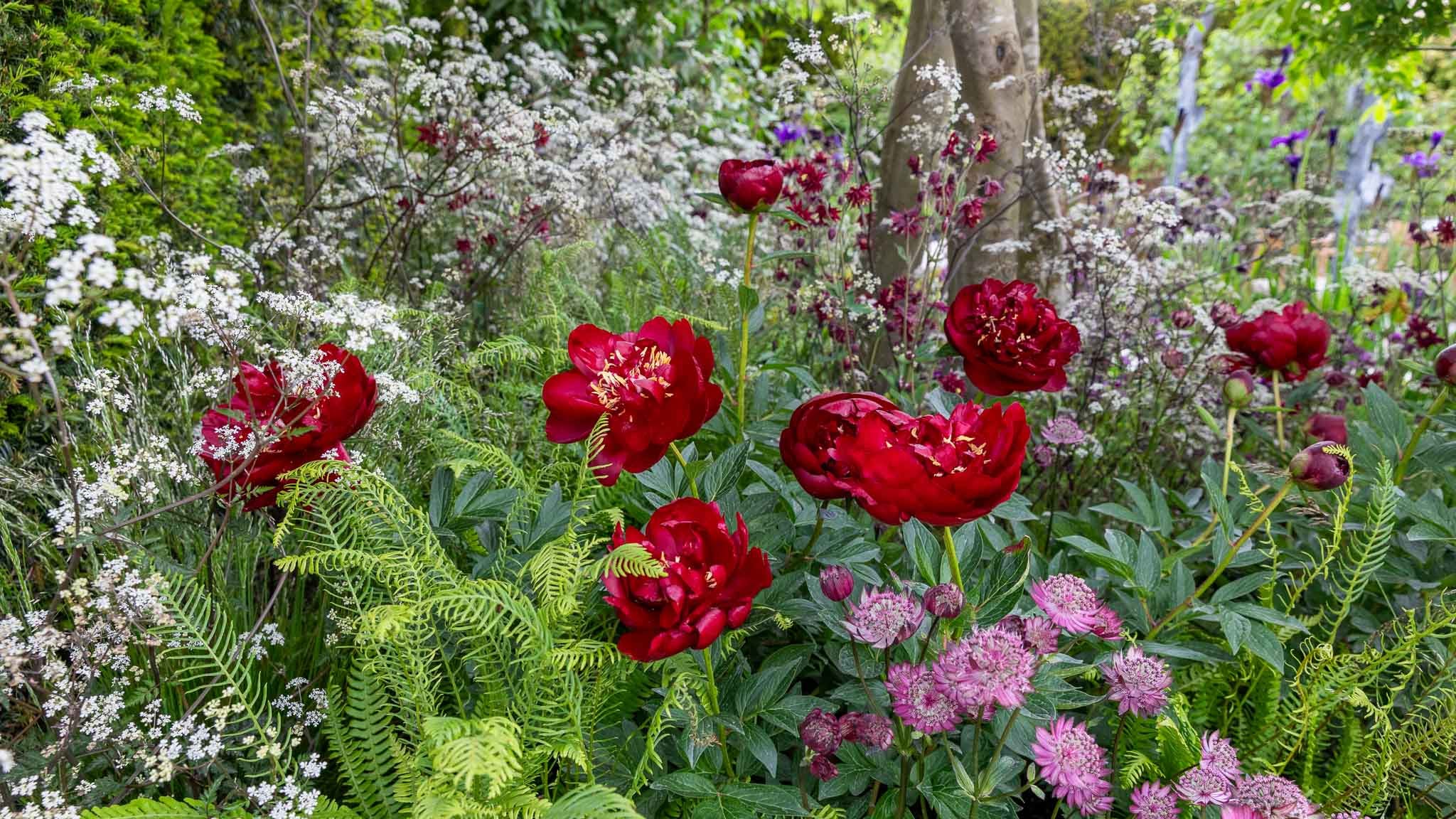
Small Show Gardens
At the other side of the show garden, the four Small Show Gardens. Smaller plots than Main Avenue, but as the years have proved, the smaller size is actually the making of these gardens. Some of the most thoroughly considered work at the show happens here. Two Golds and two Silver-gilts this year. Here they are in no particular order.
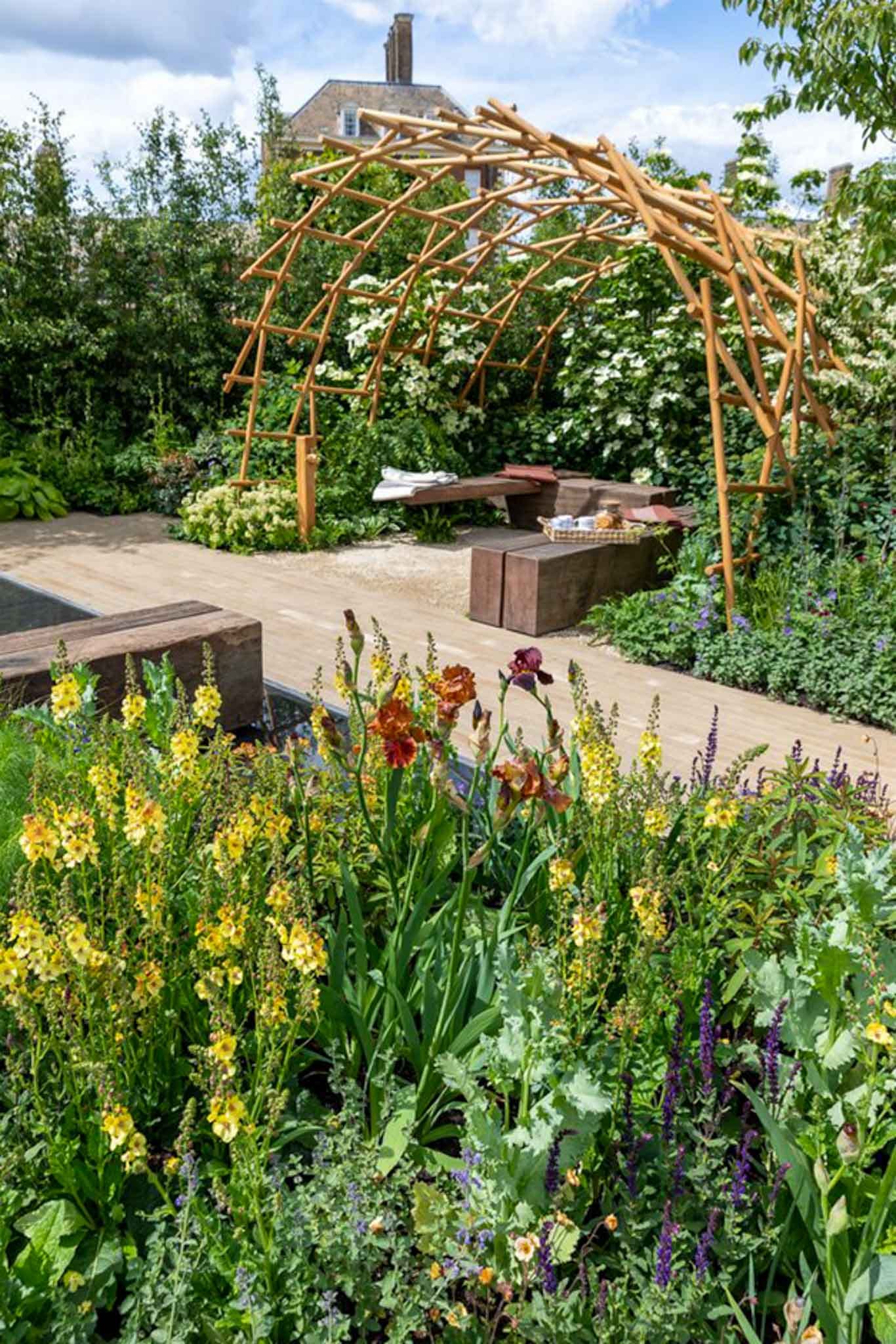
Trussell’s Together Garden — designed by Rob Hardy. Gold AND Best Construction.
And then there was Rob Hardy. Trussell’s Together Garden. Gold AND Best Construction. I happened to be sharing a glass of energy (champagne, let’s be honest) with Rob’s family when RHS Director General Clare Matterson bowled over with the Best Construction Award to bookend his Gold. What a moment.
Rob’s garden is built around a reciprocal timber frame, paths that intersect rather than lead from A to B, and a clever rise-and-fall water feature that drains to reveal further seating. The design ITSELF describing the way food banks and the communities around them reciprocate care.
The planting reads like a small love letter to early summer: Iris ‘Red Pike’, Euphorbia ceratocarpa, Prunus maackii ‘Amber Beauty’, Cerinthe major ‘Purpurascens’, Baptisia ‘Purple Smoke’, Verbascum, Thalictrum, and at the rear of Rob’s structure the most flamboyant Cornus ‘Venus’ I have ever clapped eyes on.
And then. After the show, the garden relocates to Strabane Foodbank in Northern Ireland. The FIRST Chelsea show garden to be rehomed in Northern Ireland in the show’s history.
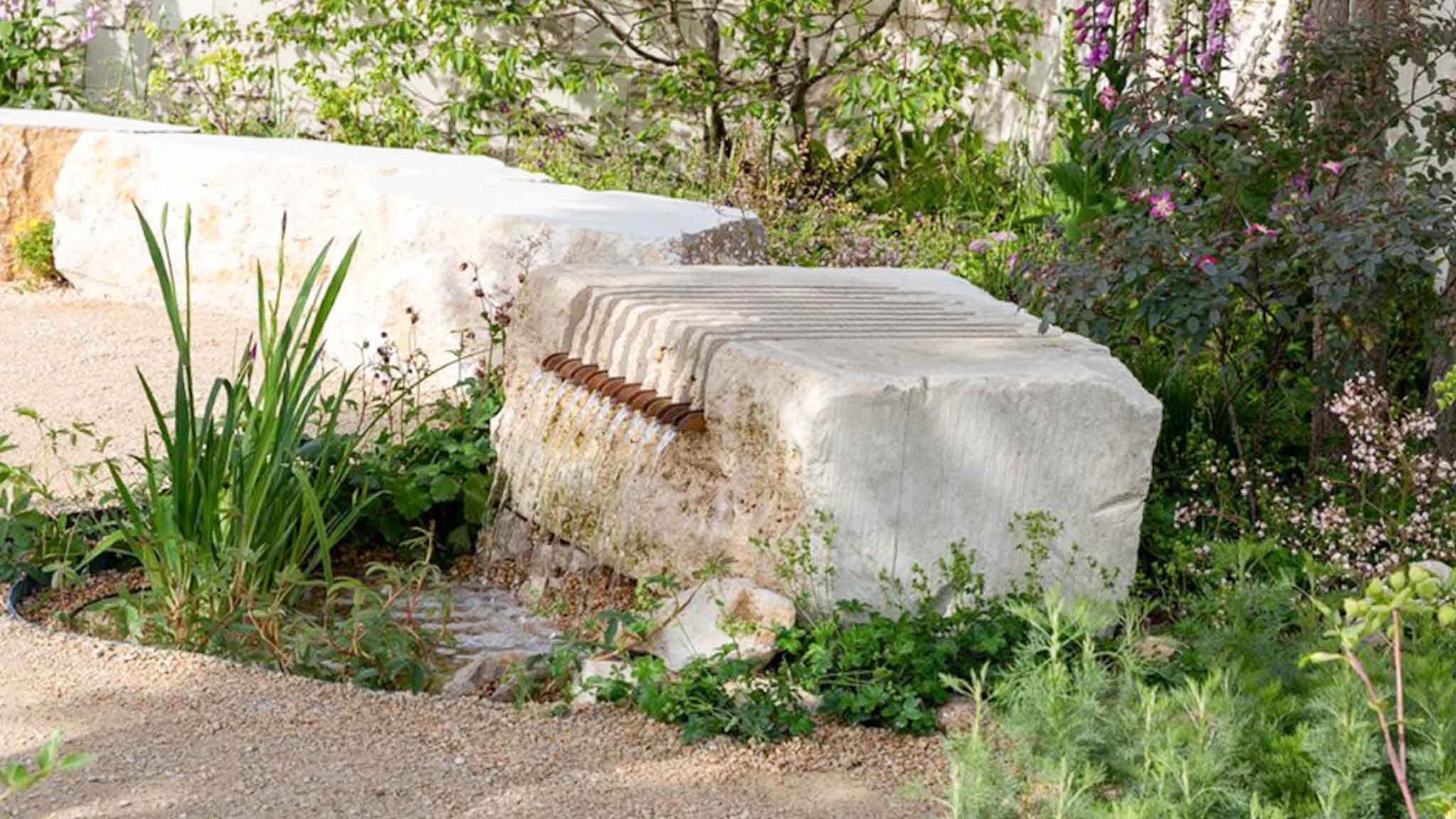
Flourish in the City — Addleshaw Goddard, designed by Joe and Laura Carey. Gold AND Small Garden of the Year 2026.
An urban-pitched garden with planting that does the heavy lifting for a city plot: Iris ‘Chantilly’ threading through, Cistus x skanbergii loose and silvery, and (Laura Carey’s own pick) Plantago media quietly flowering in the mix. A reminder, if any of us needed it, that the gardens in urban environments have to work super hard in the harshest surroundings. Calm, understated and beautiful. And certainly an example of how to flourish in the city.
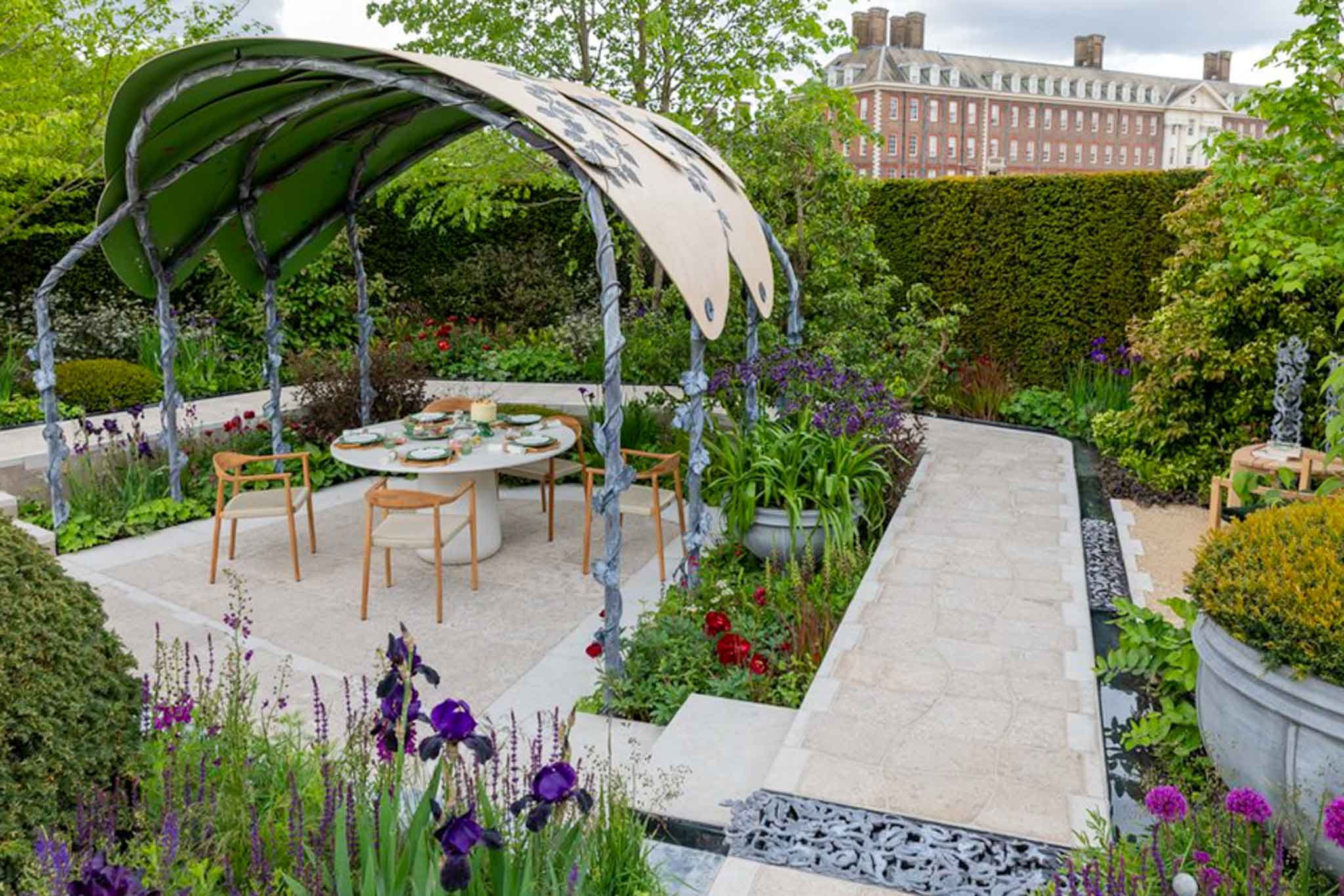
The Boodles Garden — designed by Catherine MacDonald. Silver-gilt.
Catherine’s third year with Boodles, and she returns with another quiet beauty of a garden. Her brief took her round the four Historic Royal Palaces (am I allowed to be slightly biased given our studio’s work at Hampton Court Palace?), and she has woven their architecture and atmosphere into the design with a deftness that doesn’t shout. Light-coloured limestone paving nods to the White Tower and Hampton Court. The central rill stands in for the Tower’s historic moat. The asymmetrical pavilion borrows from the decorative ceiling of the Picnic Room at Queen Charlotte’s Cottage at Kew. (How DOES she find these references and weave them in so beautiful?) The planting is romantic, jewel-tone, properly designed. Catherine is one of our most considered designers and it shows. And after the show, the trees and plants relocate to the 20th Century Garden at Hampton Court Palace, where Catherine has been working on a new planting scheme with Historic Royal Palaces. A garden with afterlife as serious as its show life.
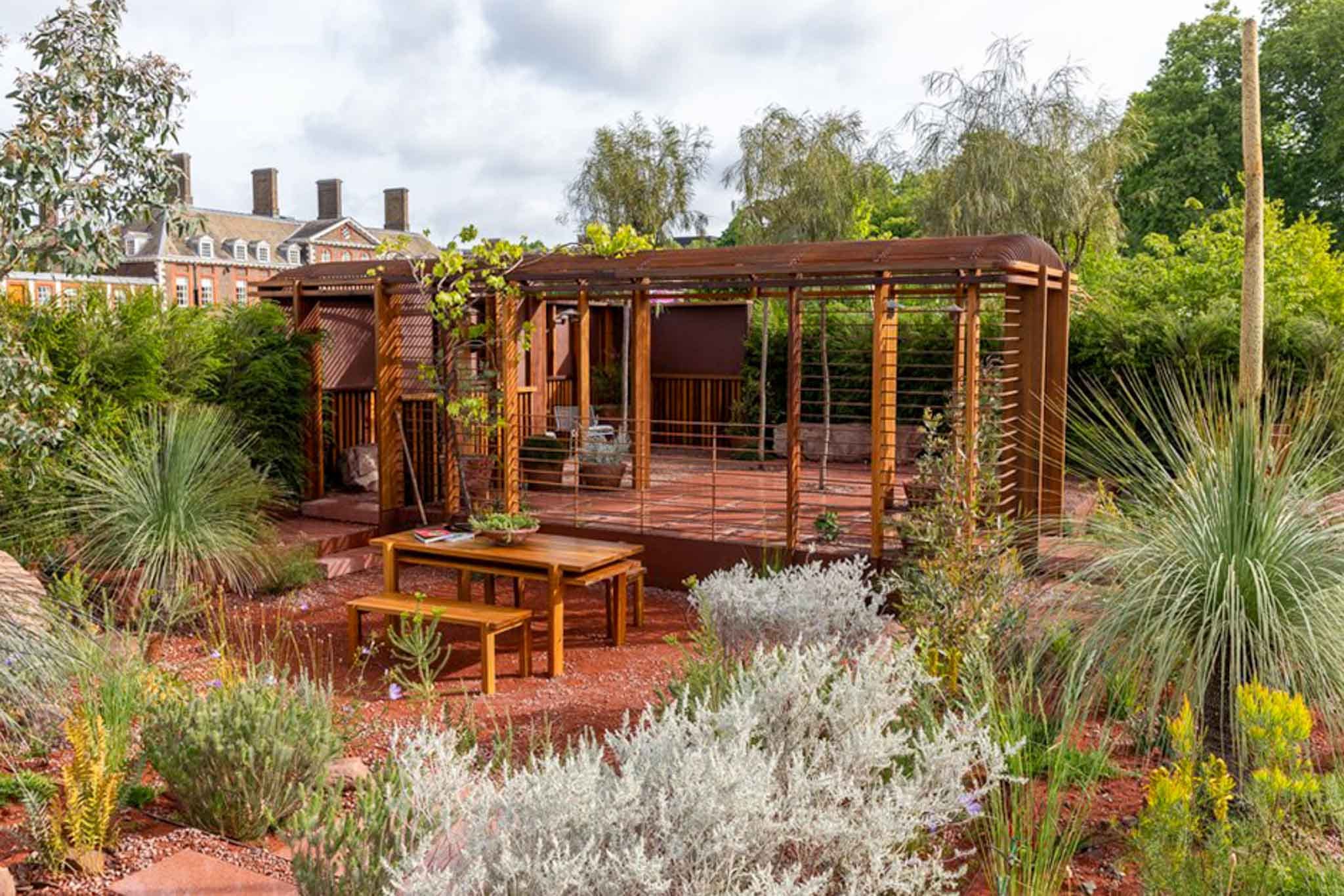
Journey Beyond the Tracks: From Adelaide to Perth — designed by Max Parker-Smith. Silver-gilt.
I announced Max in last week’s preview as a properly huge talent. Apologies Max for embarrassing you before the event, but I’m pleased to say that he’s delivered, again. The garden is structured around a transverse train-carriage form that divides the plot in two: on one side the Western Australian outback in tiered, climate-resilient planting; on the other, Adelaide’s National Park City vision in trees and natural water corridors. Eucalyptus, Callistemon, Hakea, Grevillea. The kind of planting palette most of us aren’t growing in southern England, but EVERY designer should be looking at right now as our seasons shift. And after the show the plants go to Kensington Gardens, the hardscaping to Longleat. (Where, since you ask, the first koalas in Europe were housed. The man does his research.) An ambitious garden asking the right questions. He’ll be on Main Avenue soon, I’m sure.
.
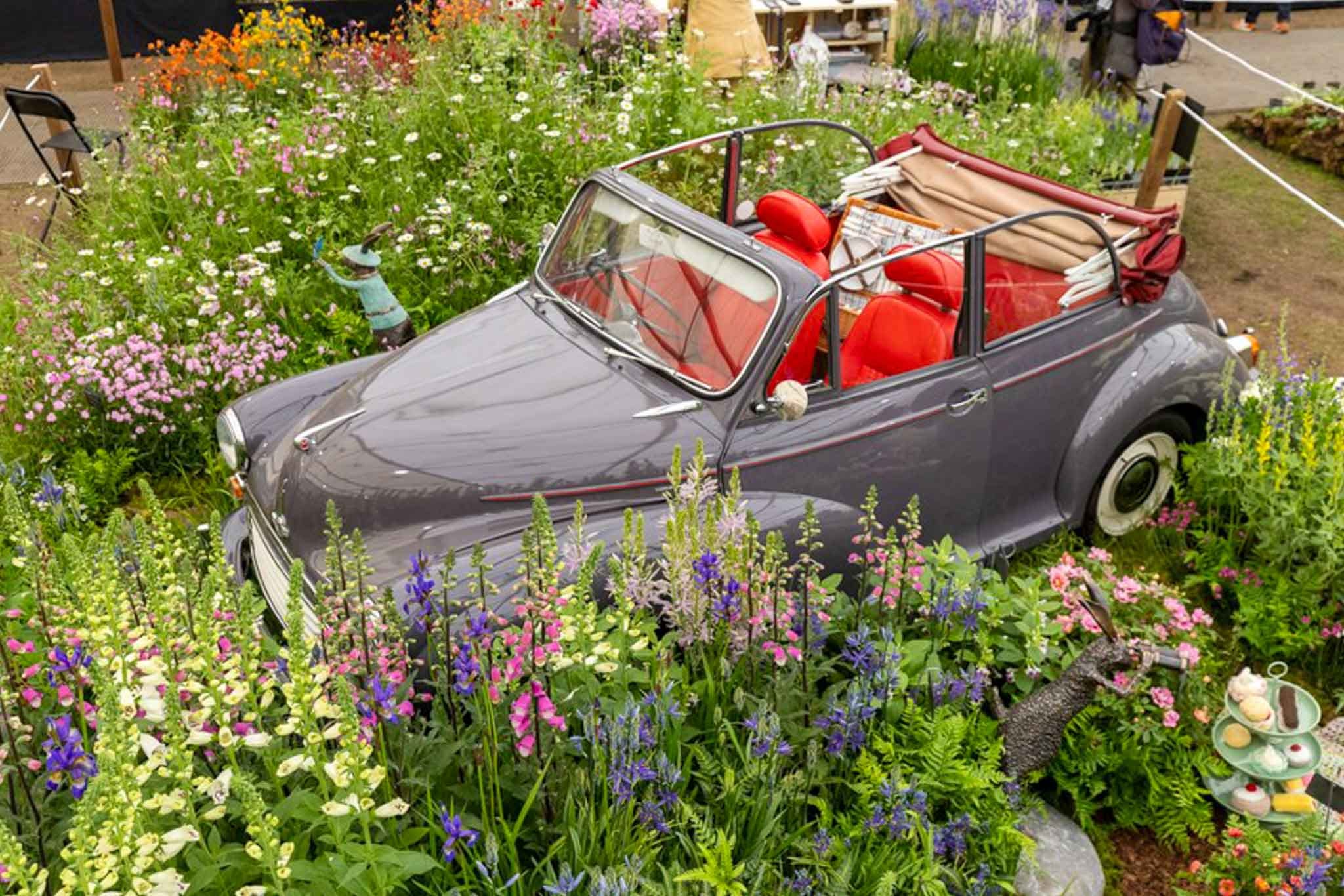
The Great Pavilion
Before we get to the main show gardens, I have to take you into the marquee. The Great Pavilion, I should say. It replaced the original Grand Marquee back in 2000, which means it’s been the Great Pavilion for 26 years and I STILL get it wrong! (The Grand Marquee was listed in the Guinness Book of Records as the world’s largest tent, since you ask. And I do think there was something a little magical about it.)
I love it in there, and I managed to spend a whole afternoon amongst its glorious offerings, deliberately eschewing the first sunshine just so I could have it more or less to myself. PRO TIP. It gets busy when it’s raining, so heading in while everyone else charges outside might feel counterintuitive. But it works. You can walk around the globe in there, geeking out on a huge array of plants that would NEVER be found together in the wild, suddenly just metres apart. BLISS.
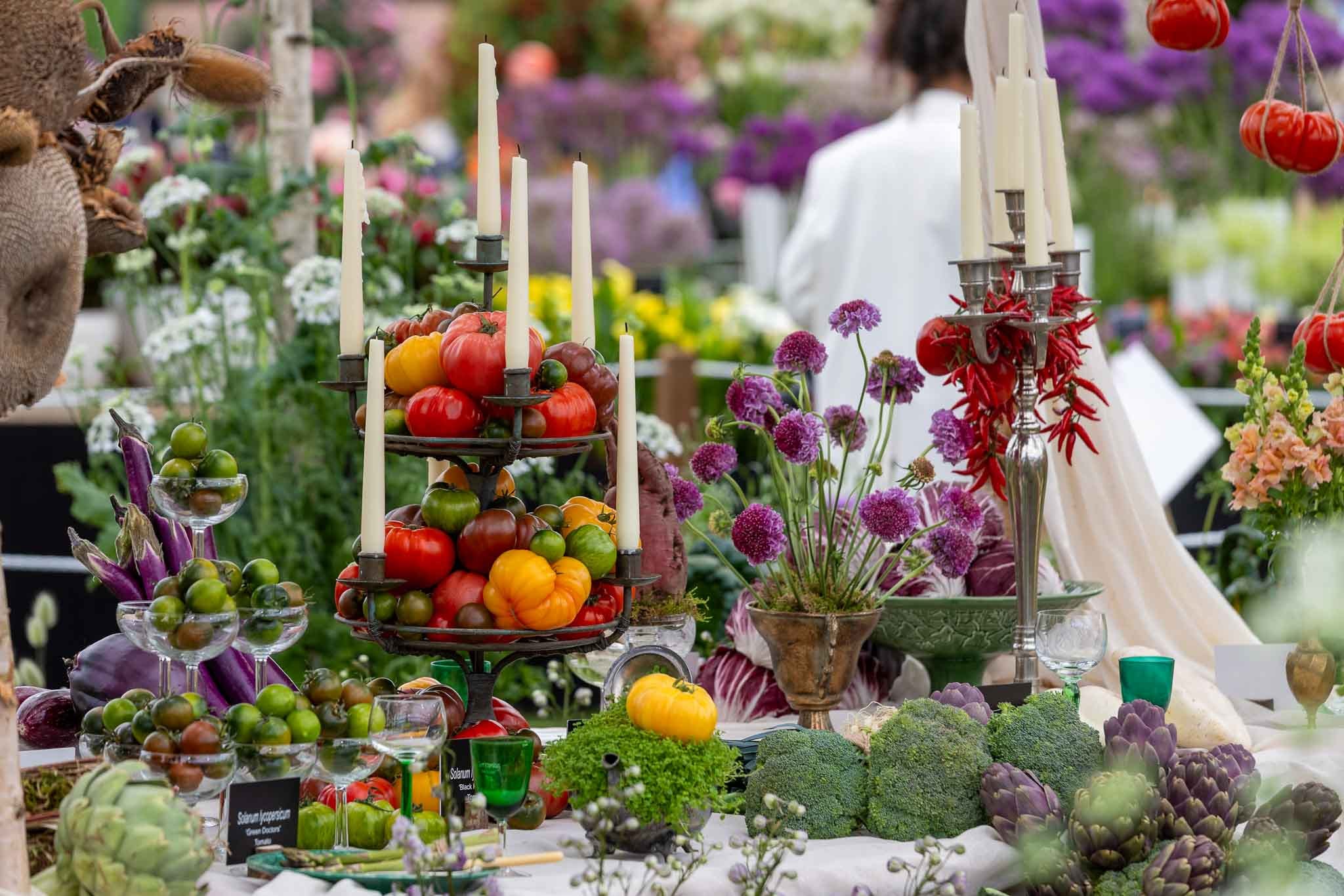
She Grows Veg Feast
Let’s start here, as mentioned in last week’s preview, and which absolutely did not disappoint. It was almost fantastically obscene in its vegetable worship. To sit at Lucy and Kate’s table and indulge and imbibe would be complete heaven. I don’t know quite why, but the whole thing felt almost Louis XIV in its decadence. Veg has never looked so delicious. As a vegetarian, I say that wholeheartedly. I genuinely loved it.
Now, when I chatted to Lucy she was dashing around putting actual plant labels on the exhibit, rather than the QR codes of the previous year. Those QR codes had linked straight to the plants on their website, complete with growing advice, tutorials, and heaven knows what else. A massive draw for any veg grower, but rather sniffed at by the marquee judges. So, labels it was. To my mind, they looked too large, cluttered things up, and in my honest opinion were not half as useful to those of us wandering through. Perhaps it’s time to reconsider the labelling in there and move with the times? Silver-gilt.
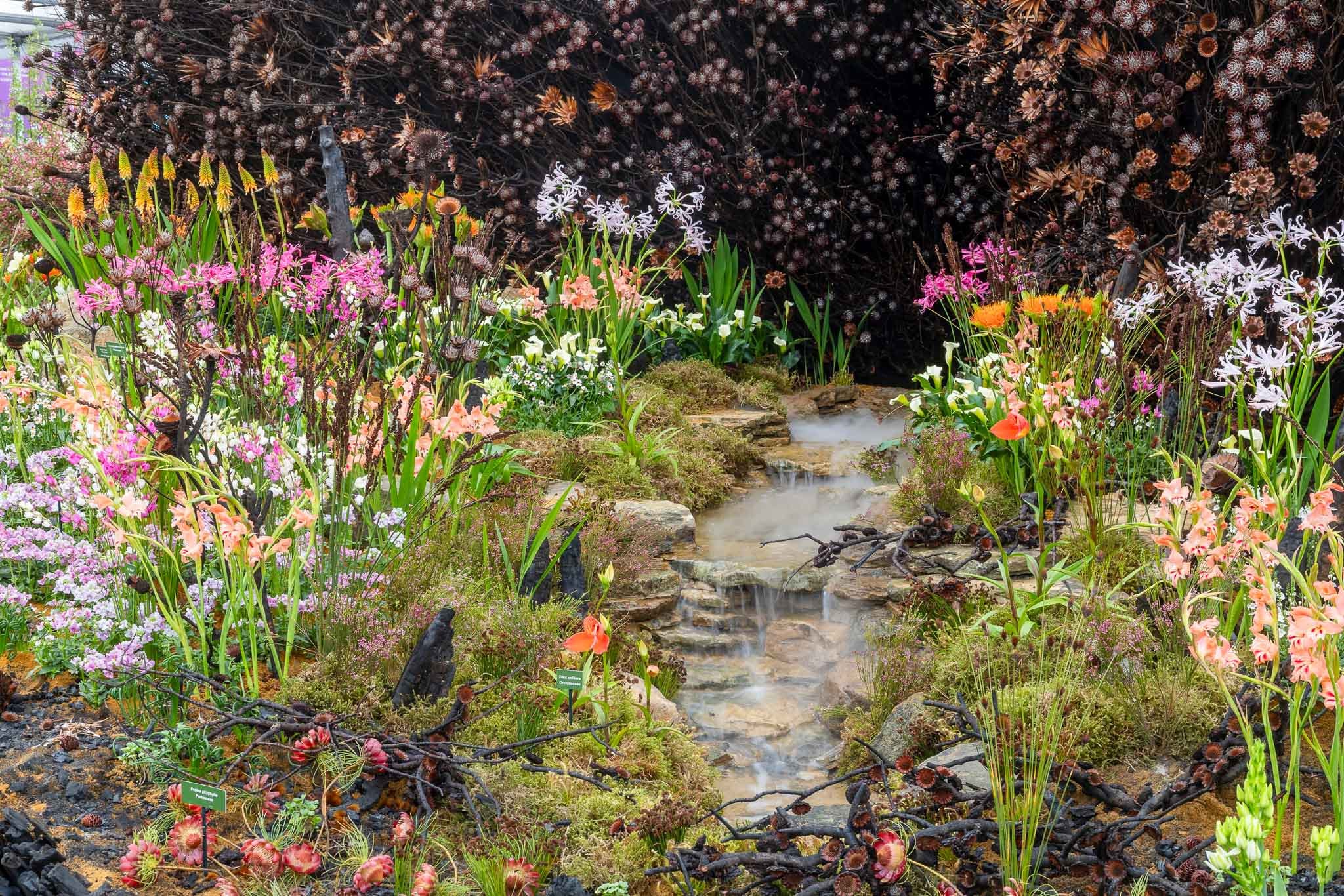
Life After Fire — Flora of South Africa. Gold AND Best Exhibit in the Great Pavilion.
The highest honour in the pavilion, and absolutely, utterly deserved. Designer Leon Kluge worked with artist-gardener Tristan Woudberg, and together they brought around 20,000 protea stems to SW3, many arranged in graded slopes of colour, running from the cool grey-white of ‘Snow Leopard’ right through to the hot red of ‘Robijn’. Streams of tannin-rich water ran through the display, evoking the peat-stained rivers of the Cape. Burnt protea skeletons and charred wood edged the whole thing, and erupting among them were Disa orchids, carnivorous plants, ferns, and arum lilies, species that burst into colourful life because fire has burned the surface vegetation first. These plants need fire every ten years or so in order to reseed and flourish. The heat cracks the seed coats. The ash fertilises the soil. That’s not just beautiful. That’s extraordinary.
What makes the story even more remarkable: floods and snow hit the farms where the team were harvesting their flowers in the weeks before the show. At one point they genuinely didn’t know if they’d make it to Chelsea at all. Thank goodness they did. And this was South Africa’s 50th year of participating in the show. So many WOWOWOW moments.
Pelham Plants
On my way to find Kevock, I gasped. Actually gasped, out loud, at this exhibit. Designed in the round and positioned where it could quite easily have been missed, this was an absolute gem. Plantsman Paul Seaborne (who I’m reliably informed is also a working GP, hence the nursery not always being open, DO check the website before you make the trip) has created something very special: a living representation of a stock garden, with propagation literally in action, set along an immersive woodland path built from locally sourced wood slices. An upturned tree stump, slowly being consumed by the surrounding planting, stood as a testament to the site’s wooded Wealden past. The whole thing was deeply personal, deeply rooted, and completely unhurried.
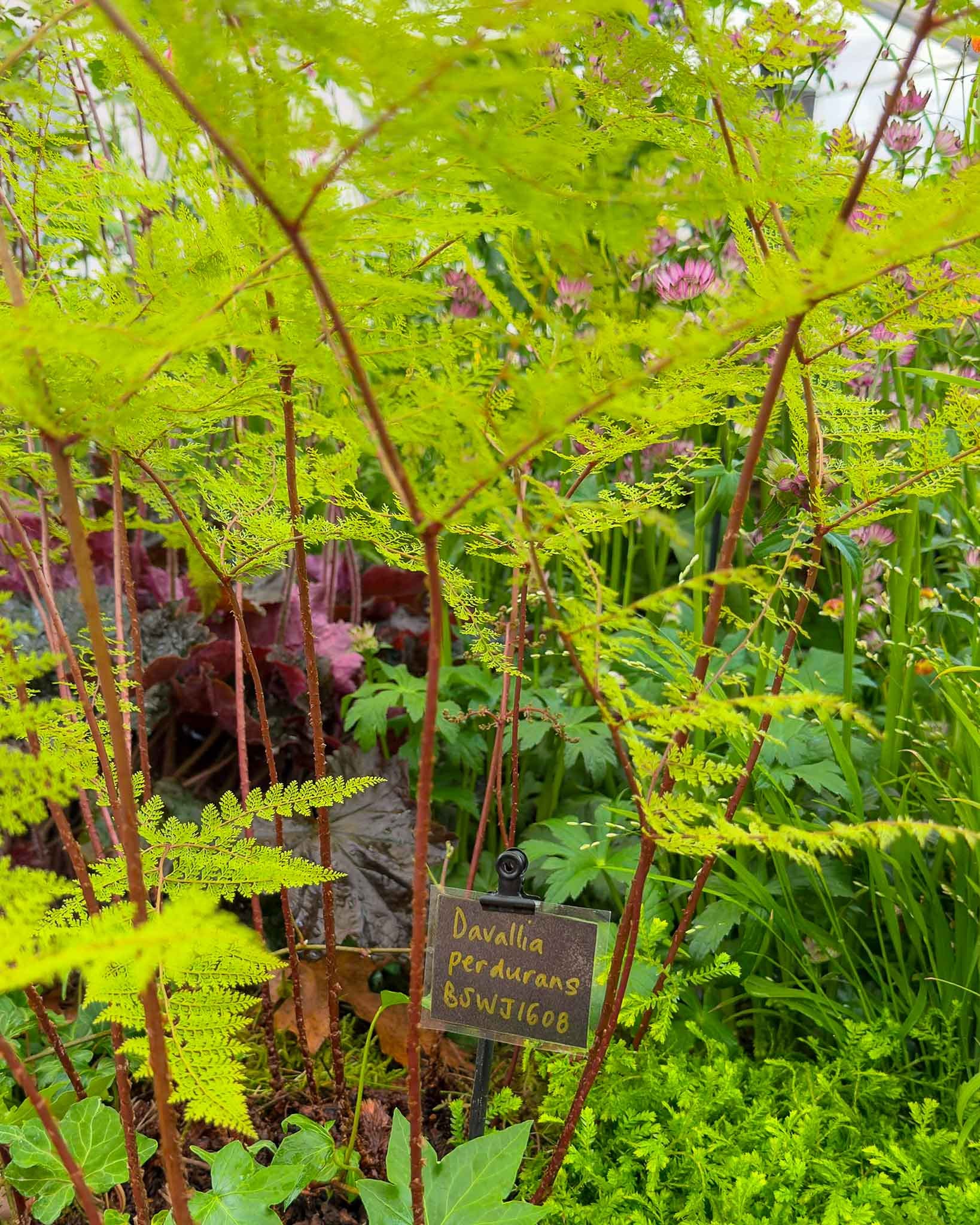
My favourite plant (I took a TERRIBLE photograph of it, obviously) was Davallia perdurans. A fabulous lime-green froth of elegant tall foliage with plum-red stems. A fern I WANT. NEED. Immediately and without apology. Gold.
Kevock Garden Plants
I make a dash for this exhibit every single year. I am not, truth be told, a natural alpine grower, but there is something about Kevock’s arrangements that gets me every time. Textural, colourful, brilliantly unusual, and raised (again!) on a round display table that works BEAUTIFULLY. The circular format lets you move all the way around rather than being funnelled in from one side and pushed back out at the opposite end. I’m hoping more nurseries will try it. This year the meconopsis (as promised) were out of this world. Gold.
Plant of the Year: Hosta RED NINJA (’Nk2021’)
Bred by Ninja Kramer (YES, that is genuinely his name) and exhibited by Sienna Hosta. Now, as I confessed in last week’s preview, I am not a hosta woman myself. But Red Ninja did it’s best to try and convert me, and almost did, at least for a minute. The leaves emerge in proper scarlet, holding deep into summer with their green margins, and unusually for a hosta it actually needs some direct morning sun to bring the colour out. The breeders worked on this for years and it shows. Sienna Hosta also walked off with the President’s Choice Award for their wider display. The British hosta growers, quietly, are knocking it out of the park right now.
Honorary mentions:
Lincolnshire Pond Plants, with a Gold. A 12m and 11m pond complete with blade waterfalls and an aquarium-style surround, and crucially, the generosity of space to actually enjoy the plants both individually and grouped without the cramping that usually makes water plant displays feel overwhelming.
Pure Grenada, their ninth consecutive Gold and nineteenth overall. Every year, a phantasmagoria of the unusual: orchids, heliconias, cocoa, nutmeg, anthuriums. Meticulously, impossibly carried off.
David Austin Roses, their thirtieth Gold, and the headline story was the launch of the ‘Sir David Beckham’ rose. The idea came from Harper Beckham herself, who called David JC Austin to ask for something beautiful for her father’s 50th birthday. The rose spent over ten years in trials, opens from soft pink into luminous white with golden stamens, smells of honey, nougat, clove and myrrh. £2.50 from every sale to The King’s Foundation. King Charles was photographed sniffing it. Naturally.
Peter Beales Roses, their thirty-FIRST Gold, more than any other rose exhibitor in the show’s history. The ‘Kate Moss’ rose: lemon to cream, brushed with soft blush pink, repeat-flowering, standing around 3ft. Kate Moss was there with her mother. But damn, I missed her (of course!)
Jacques Amand: TWO Gold medals, because one exhibit of extraordinary bulbs was apparently not enough. Hippeastrums, Scadoxus, Gloriosas for one; alliums, arisaemas and those extraordinary hardy orchids for the other. BULBS. Obviously I was done for.
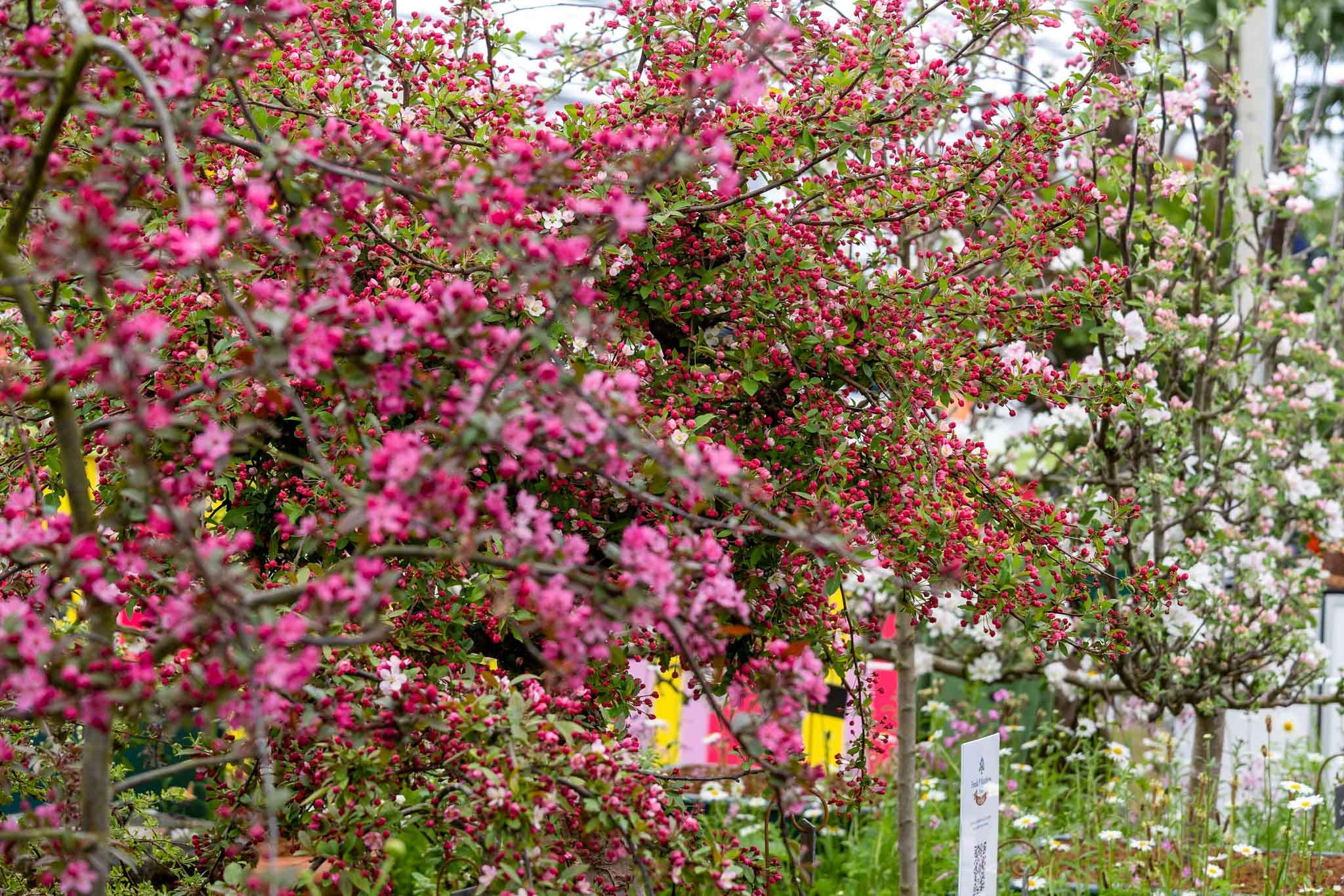
Frank P Matthews, Gold in only their second Chelsea appearance and coinciding with their 125th anniversary. I still genuinely cannot explain how they had so many fruit trees all in blossom at the same time. Chelsea-week Malus timing is notoriously brutal to achieve. They nailed it.
Flowers from the Farm. Silver-gilt. A miniature flower farm at the heart of the Great Pavilion, brought together by the trade association of UK flower growers and designed by Penny Dommett. Georgie Newbery and Common Farm Flowers were among the contributors. (Georgie has a Substack of her own, by the way. We are, clearly, a species.).
Imogen Perreau’s Beltane exhibit, RHS x Citi Season of Abundance
I’ll be honest, I hadn’t come across Imogen before, which made chancing across this exhibit of delight even better. A designer I didn’t know, doing something I genuinely hadn’t expected, at the heart of the pavilion around the monument. It is a commissioned centrepiece rather than a judged competitive entry, so there’s no medal to report, but still, this was really something.
The concept draws on Beltane, the Gaelic festival that marks the exact cusp of spring and summer, which is precisely where Chelsea falls every year. Six multi-stem trees anchor the landscape. Foxgloves punctuate a stone basin. Peonies from Primrose Hall tumble in. Lemon balm. Chamomile. Elder. Ferns unfurling. The whole thing lush, unhurried, and green. And running alongside it all week: herbalist Brigit Anna McNeill, demonstrating plant-based tinctures and remedies using the actual plants in the installation. A flower show that briefly becomes a herbal medicine practice. Wonderful
Not everyone saw the Beltane connection as apt. Robin Lane Fox was fairly withering about it in the FT - I disagree, fairly strongly. The flowering hawthorn is Beltane’s sacred plant, blooming at this exact moment every year. Its traditions include decorating homes with flowering branches, gathering elder, chamomile and lemon balm for seasonal remedies, celebrating the natural world at its most exuberant. Imogen Perreau planted ALL of these. Every single one. Lane Fox went for the fire and the sacrifice. The garden went for the hawthorn and the healing. I know which one I think has more to say.
Imogen Perreau. Remember the name.
And there are simply too many exhibits to do proper justice to here. Every year I think the Great Pavilion has peaked. Every year I am wrong.
Last, and emphatically not least: the floristry
RHS Chelsea floristry always makes my head almost explode with the intricacy and the ability that I could never hope to come even close to. But this year, one exhibit stopped me completely in my tracks. The Creative Spaces category at Chelsea has no theme or brief, so the exhibits within it can’t be formally judged. Instead, the RHS Floristry Ambassadors choose their standout piece.
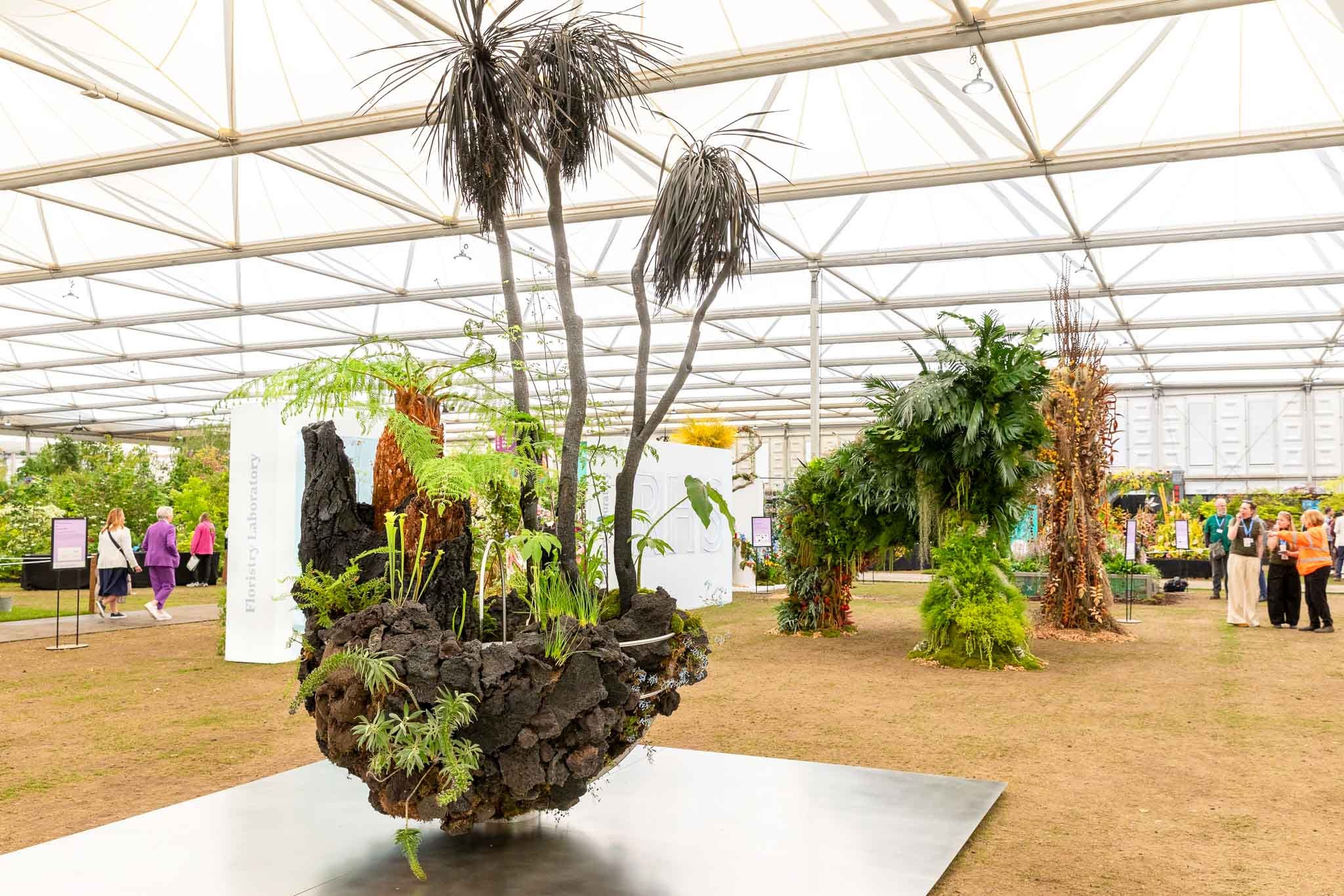
This year, that award went to OF A GARDEN: Slow Dream, by OF A SPACE in collaboration with Wagner Kreusch and Frida Kim. Icelandic architects. Yes, really. (I say this because I chatted with them, and it was one of the more genuinely unexpected conversations I had all week at a show not short of unexpected conversations.)
What they described was this: the piece imagines a garden as a territory still in formation. A process of becoming, rather than a finished (or finishing) thing. Burnt elements marking cycles of failure and renewal. Blackened matter evoking volcanic landscapes. A dark palette. Something familiar and something unknown at the same time. Plants growing back from rock, tenuously, insistently, as if they have absolutely no idea they’re supposed to have given up. Spellbinding is genuinely the only word. And they gave me my own tiny piece of black, beautiful rock. Which is by my side as I type.
Trade stands, and a confession about my home ground
Last week’s preview told you, firmly, not to miss the trade stands. I meant it then and I mean it now.
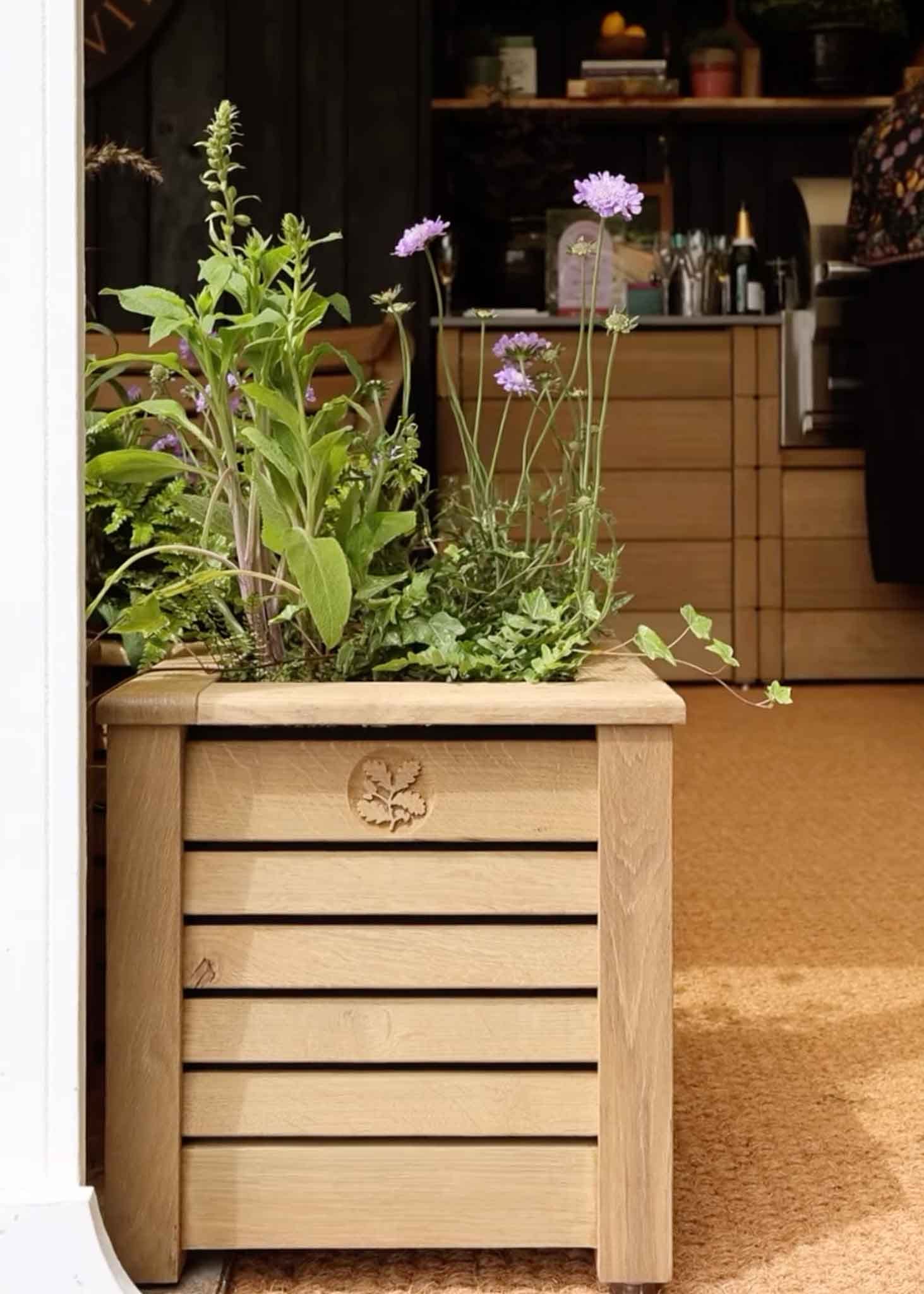
Huge congratulations to my dear friends at Gaze Burvill, who won the RHS Chelsea Sustainable Garden Product of the Year 2026 for their National Trust Planters. Genuinely deserved. Here’s what these planters are: solid English oak, made from characterful offcuts that would otherwise go to waste (their own phrase is ‘Waste into Wonder’), certified Grown in Britain, with a twist-and-lift detachable crown that reveals a removable liner made from 100% recycled plastic. Rotate it anticlockwise, lift it out, use a different liner, then put the new planted liner back in. For established plants whereb the foliage might get in the way of the crown, the crown even separates into two L-shaped pieces so the frame can be serviced without touching the foliage. Ten percent of every sale goes directly to the National Trust’s woodland conservation programme. Ten-year warranty. Made at their workshop in Hampshire. That’s not a garden product. That’s a design solution.
I should declare my hand. I’ve designed two of Gaze Burvill’s Chelsea stands over the years (you can see some of the images on our website here), so I know better than most what goes into achieving an award like this. It is CONSIDERABLE. The Burvills are genuine friends, we celebrate, commiserate, party and holiday together, and I could not be more delighted for them.
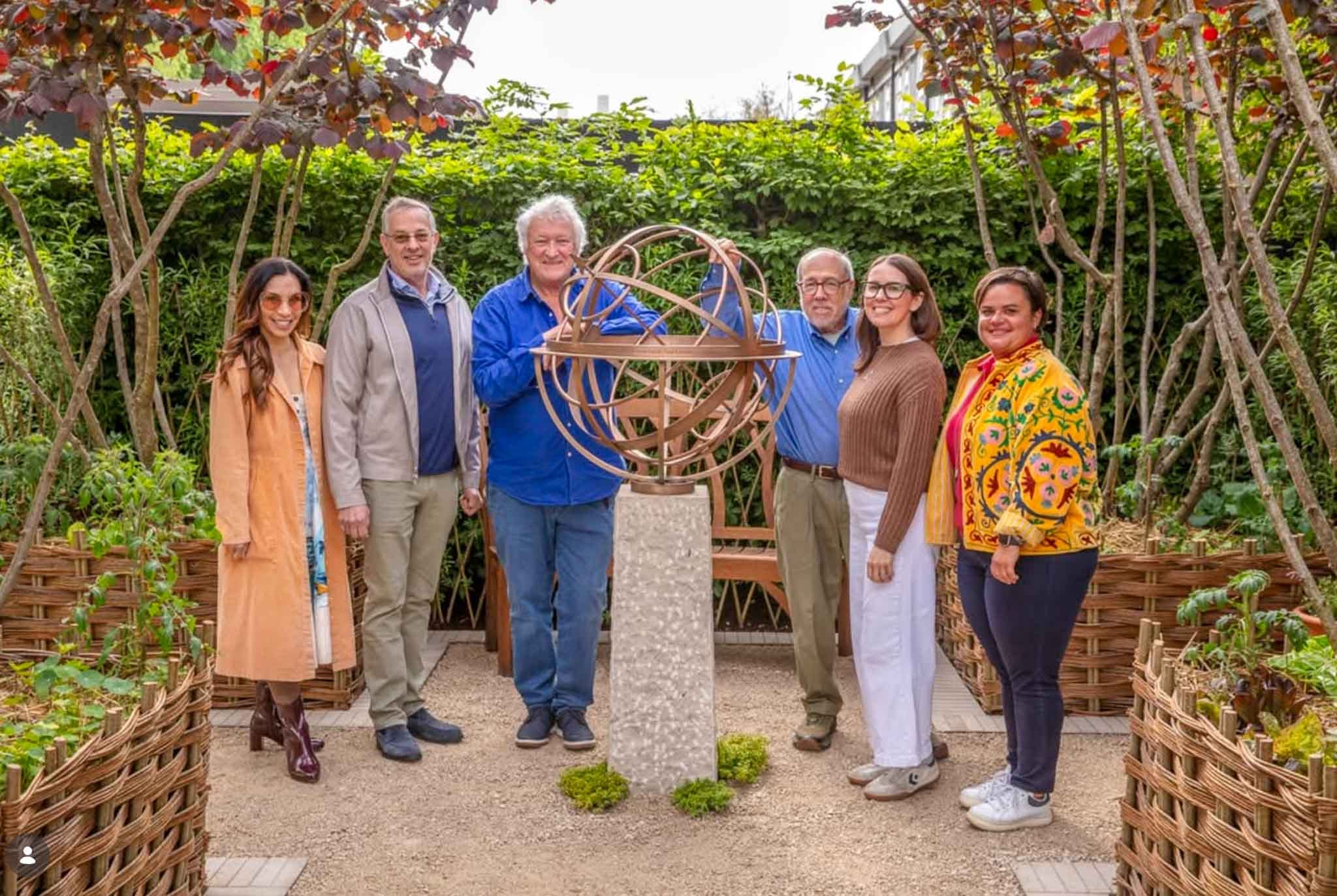
And down the road, to my other home ground: the David Harber stand, which took Best Tradestand. The garden was designed by New York landscape architect Ed Hollander, and it was beautiful. Not a conventional stand at all but a working garden rooted in heritage growing traditions. Woven willow. Heirloom vegetables. Heritage fruit trees. The stand debuted Nexa, a new large-scale sculpture with copper mesh woven into Harber’s signature bronze Verdigris patina, a suspended open ring forming a central void that frames views through and beyond the piece. As the light changes, so does the sculpture.
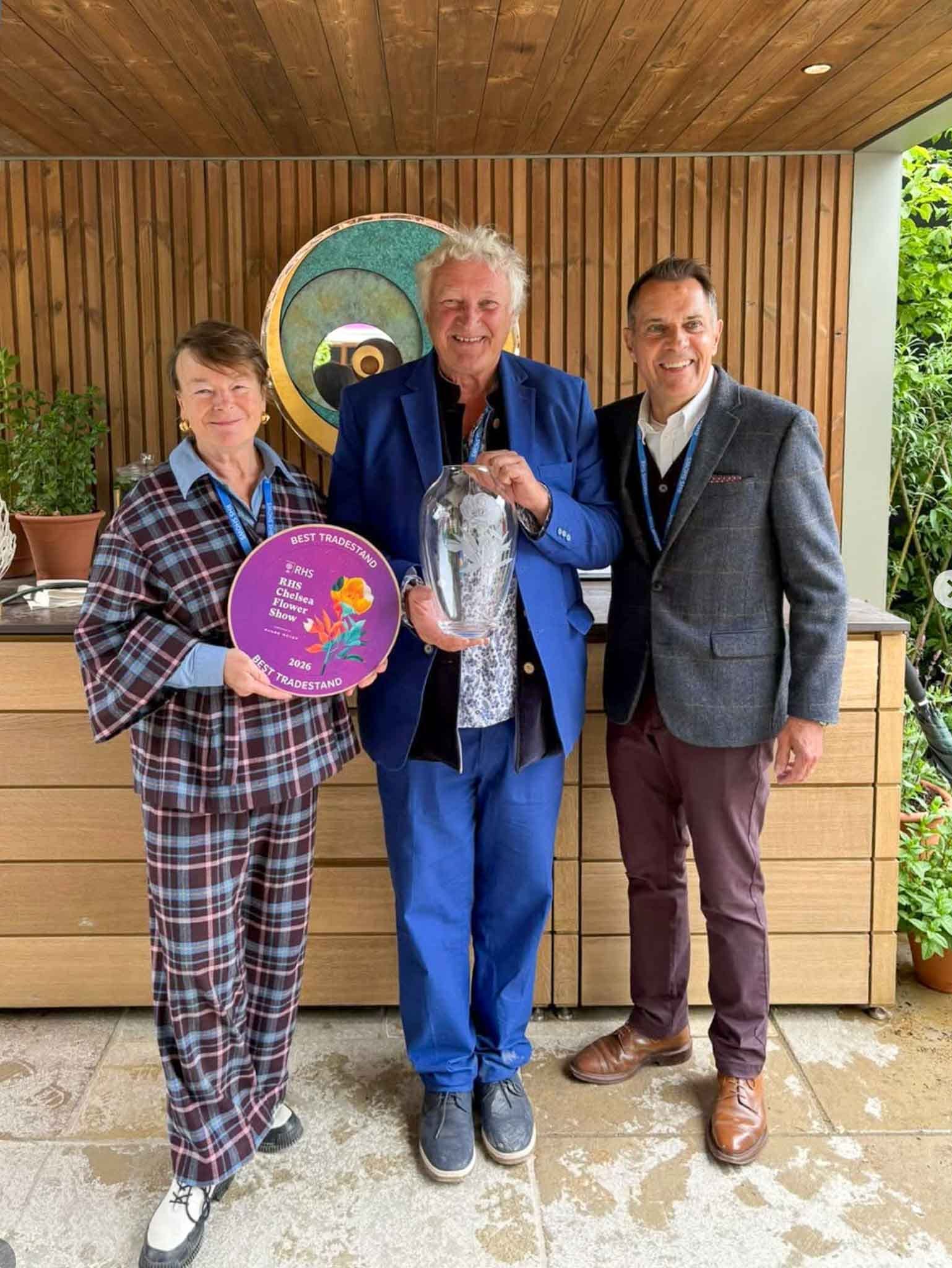
David Harber makes sundials, sculptures and water features from his studio in Oxfordshire, and holds the Queen’s Award for British Design and Craftsmanship twice over. The Harbers, like the Burvills, are genuine friends. I know exactly the elation that awards like these bring and was able to share in it. What a moment.
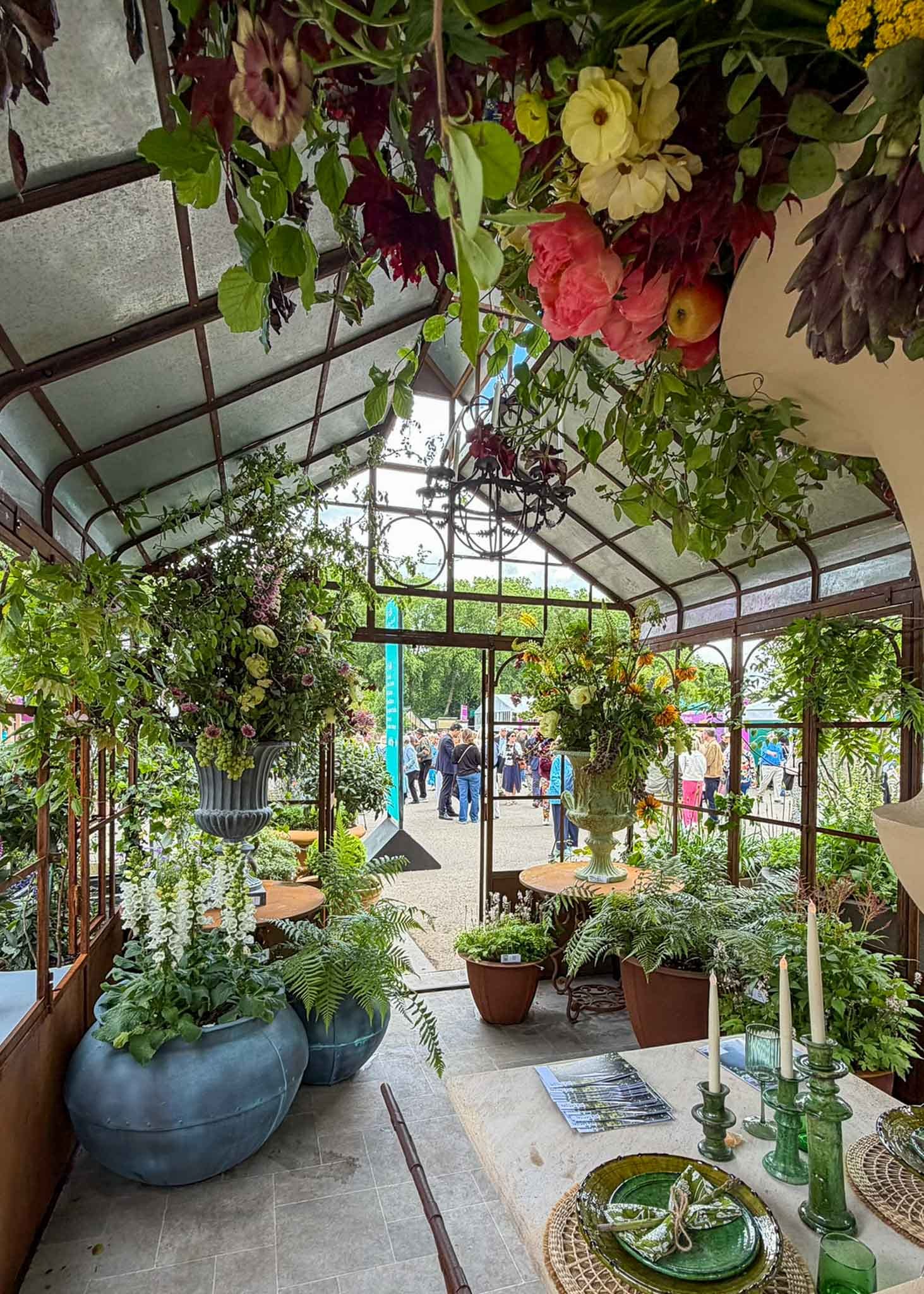
In other news, there was one stand that stopped me entirely in my tracks. As I rounded the corner from the Bullring entrance gate, my jaw dropped when I saw Capital Garden Products’ Pavilion Glasshouse. OH. MY. GOD. Extraordinary. A metal structure in a beautiful rusty finish, available fully glazed, or without glass at all, at which point it becomes a rather magnificent open garden building, architectural and sheltered and entirely its own thing. Available to order in metre-length bays, so you specify exactly the size you need, then pay accordingly. The one at the show was 7 metres by 3 metres, double doors on all sides and ends. If you don’t fancy the rust finish it can be painted in any RAL colour you fancy. I want one. I do not currently have the space. This is a problem I am now actively working on.
The houseplants, the food, and the very best of festivals
Next, let’s visit the houseplants area, which, in my view, is the best-kept secret lunch spot at Chelsea, a tip for next year, as there’s only one day left now. I’m not in the Spring restaurant budget (though I did linger outside to collect my tour group and admired the blissful shimmering floating umber chiffon entrance).
For three days on the trot, lunch for me was The Plant Café at The Potting Shed: their Vegetarian Burger with 20-Ingredient Garden Salad. All bought and paid for. All entirely delicious. Not remotely sorry.
The houseplants area itself, though. I was with friends who had never been to Chelsea before, and I watched them step under the leafy canopies of the deciduous trees, exhibits all around, and just absorb it. ‘It feels like the very best of festivals,’ one of them said. They were NOT wrong. So, to my favourite house plant exhibits.
Martha Krempel’s The Composer’s Cabin. Silver.
Martha’s concept draws on the power of peatlands, horticulture and music, set within a landscape inspired by the wild moors of West Penwith and the subtropical planting of the frost-free Cornish coast. Martha dissolves the boundaries between inside and out, mirroring leaf shapes and forms so that the Monstera deliciosa and Philodendron inside the cabin reach towards the Tetrapanax papyrifer and Fatsia polycarpa beyond the walls. Inside, a 17th-century cottage quietness. And at its heart, a Steinway and Sons Spirio grand piano, surrounded by lush planting.
Here’s the moment I loved most, a Chelsea moment I’ll treasure in years to come. Martha demonstrated her apparently impressive pianist skills. We applauded. And then we realised, the Spirio is self-playing! She was entirely, brilliantly acting. We rolled with laughter! What an absolute delight!
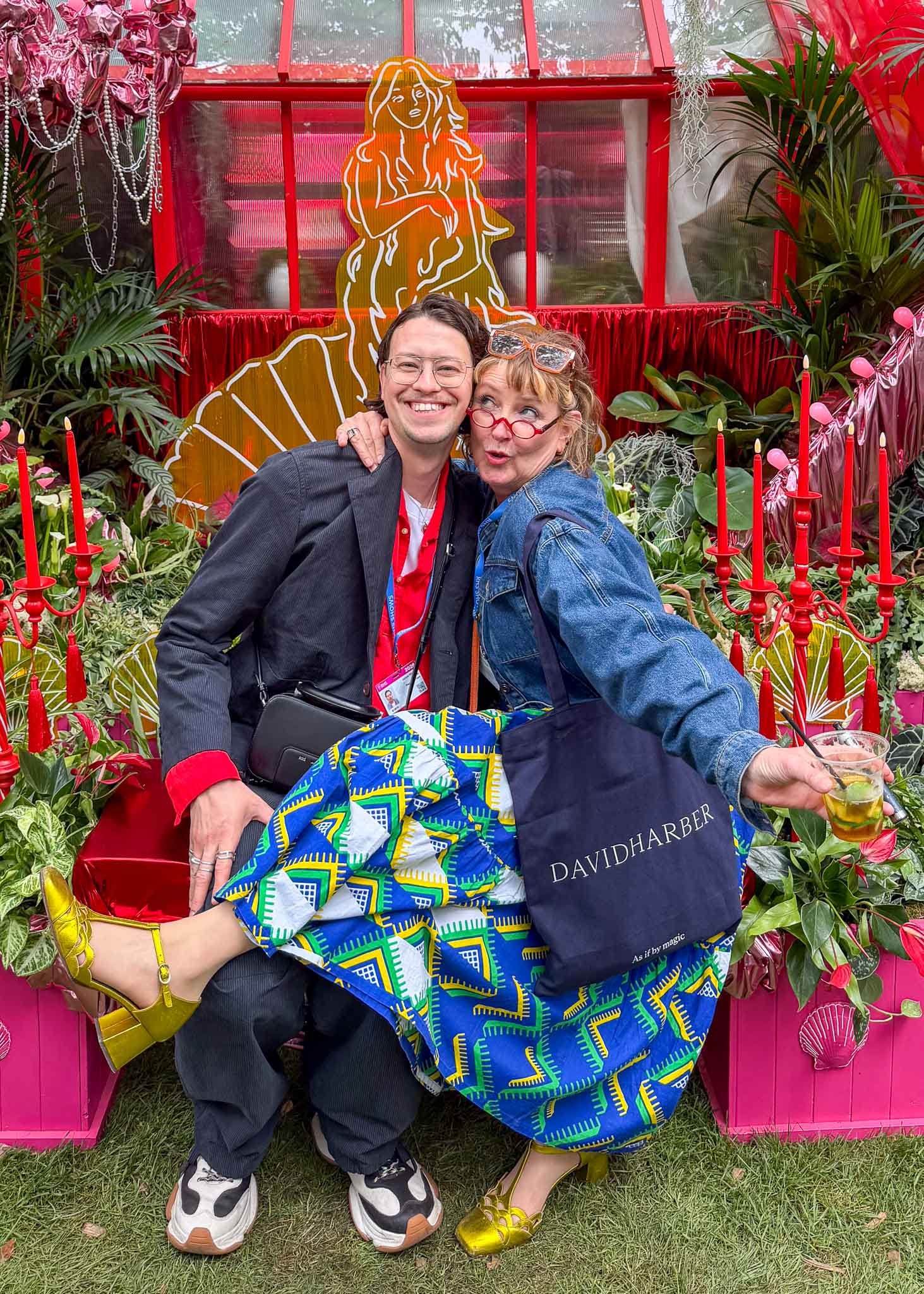
Lovehoney presents Aphrodite’s Hothouse. Gold.
I said in last week’s preview that I wasn’t entirely sure how the Chelsea public would take it. The answer was queues around the block. Perhaps the RHS visiting public aren’t quite as pearl-clutching as I’d imagined.
I’ve admired James Whiting’s work for years. Indoor plant styling is an art form, every bit as demanding as floristry, and like floristry, it is entirely beyond my patience. James is a past master, and he was kind enough to give me a personal tour, encouraging me to engage ALL my senses (ahem) in each area of the exhibit. Reader, I did my best.
Designed as the ultimate pleasure garden: a hothouse that is lush, fragrant, and actually, more than a little bit naughty. A Tunnel of Love dripping with sultry orchids, glistening Anthurium, pendulous Nepenthes and vines that coil and entwine with knowing intent. Among the exuberant foliage, sculptural forms peek out, blurring the line between botanical curiosity and boudoir wink. Devotions to love, flirtation, lust and longing. And it wasn’t just the Philodendron erubescens blushing at the accompanying ‘accessories’. Rapturous applause to the RHS for encouraging and supporting its inclusion. Plants, after all, have been performing elaborate seductions for millennia. They are rather good at it.
The Spacelift conversation
In last week’s preview I said I wasn’t going to pile in on the AI conversation. This week, having walked the show and spent proper time with Matt Keightley over a cup of tea and a sit-down, I’m ready to say what I think.
Here’s what I learned over that brew. Matt has shaped the Spacelift software himself. The design theory inside it is HIS. So, when somebody uses it, what they get isn’t a generic computer-spat-out garden. They get a Matt Keightley garden, scaled. And he is inviting other garden designers to contribute their own design DNA to the platform over time, so Spacelift will offer a variety of designer voices, not just one. Though, he hasn’t asked ME to contribute yet!
The proposition: good garden design, at an accessible price point, for the people who can’t reach the cost for a full bespoke project.
I’ll be honest. I kind of agree, that this is needed. At our own studio we offer a Small Project Service that runs on, kind of, similar principles. We offer properly designed gardens at a fee structure and documentation aimed at people who can’t commission a full bespoke piece of work. I believe, very strongly, that good garden design should be accessible to all.
In a climate crisis, with the UK’s gardens growing in number and people quite reasonably wanting them designed properly, more well-considered, biodiverse, sustainable, well-being-focused spaces should be APPLAUDED into existence. Not gate-kept by those of us at the top of the market.
Everything changes as computers get more involved in creative work. We’ve seen this film before. When CAD took over from hand-drawn plans a decade or so ago, I and every designer with a soul wailed about it (and I still genuinely MISS hand-drawing, you have NO idea how much). But CAD speeded things up, opened the profession to more people, and let us spend more time on the actual design thinking. I’d rather a serious designer with proper design theory was leading the AI conversation in garden design than a tech company doing it alone. And if Matt wasn’t doing this, somebody else would. Possibly without caring quite so much about what makes a garden good in the first place.
His Spacelift stand took a five-star tradestand medal at the show. Walk them with an open mind I say.
A quick thank you to my paid subscribers who make My Real Gardens possible.
On the other side of the garden gate this week:
• Walking Main Avenue with me, large show gardens, one at a time, no rush.
• Alexandra Noble’s Range Rover Cloister, and the question of the car
• Frances Tophill’s King’s Foundation garden, the gnome, and the line that genuinely floored me
• Project Giving Back’s farewell, and why I came away more reassured about 2027 than I expected
• The garden I could happily have moved into and started pottering immediately
• Two women on Main Avenue out of nine. I’m saying it, and I’ll keep saying it
